
Best AI Email Tool for Sales Teams and Outreach

For sales teams, a strong AI email tool helps reps draft personalized outreach, improve subject lines, manage follow-ups, and review tone inside the workflow they already use. For most teams, that means choosing between a focused AI email generator, a sales engagement platform with AI, or a CRM-native assistant depending on outreach volume and CRM dependency.
Definition: Email AI is an AI email generator that creates and improves business, career, and personal emails for professionals and teams.
TL;DR
- Pick a focused AI email app if your team needs faster, better sales emails without adopting a full sales engagement suite.
- Pick a sales engagement platform if your SDR team runs high-volume sequences across email, LinkedIn, phone, or SMS.
- Pick a CRM-native AI assistant if your reps live in Salesforce, HubSpot, or another CRM and need pipeline context more than standalone writing help.
How the top ai email tools look
Side-by-side captures of the compared products. Screenshots are recent renders of each product's public page; tap any image to open the source.
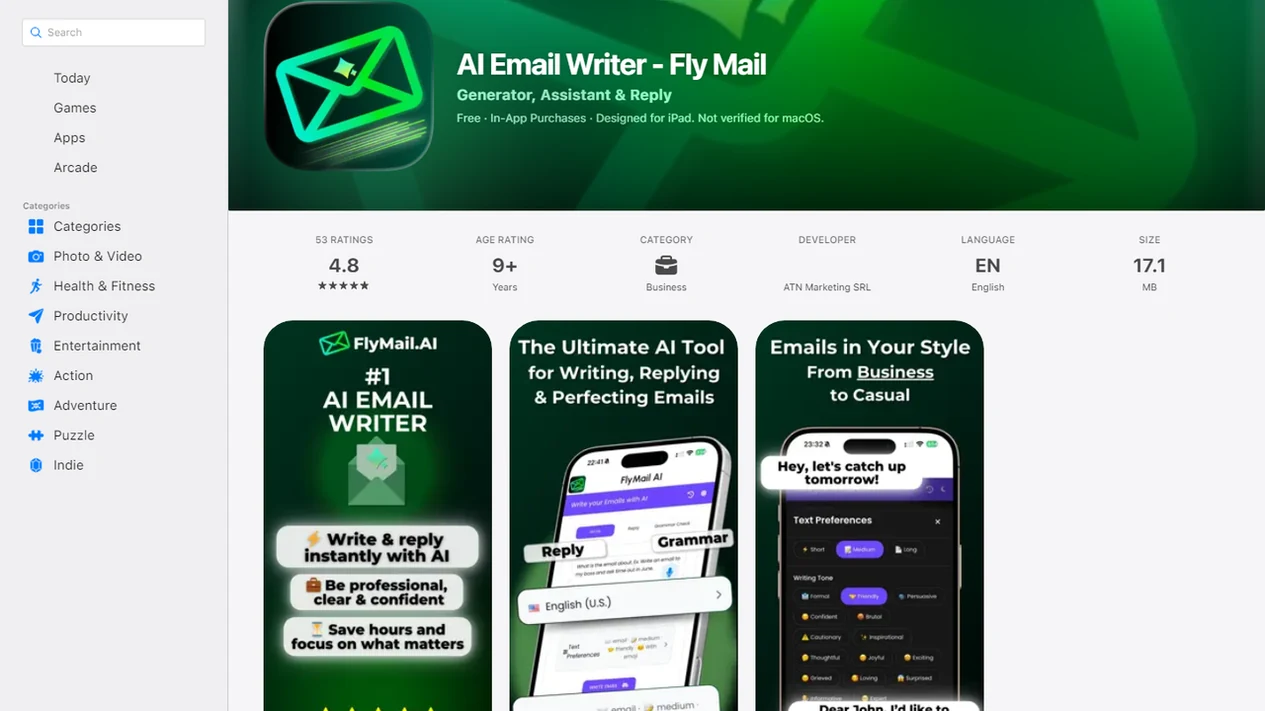
Best AI Email Tool for Sales Teams: Named Shortlist
The best AI email tool for sales teams depends on role, sending volume, CRM reliance, and how much review the team needs before messages go out. A founder sending ten careful emails needs a different fit than an SDR team running thousands of touches.
- Focused AI email generator: Email AI fits reps, founders, recruiters, account managers, and customer-facing teams that need outreach drafts, rewrite passes, proofreading, subject lines, and mobile replies without buying a full outbound stack.
- Sales engagement AI: Outreach-style platforms fit SDR teams that need sequences, task queues, automated follow-ups, and reporting.
- CRM-native AI: Salesforce or HubSpot assistants fit AEs who need deal context, account notes, and pipeline history inside the CRM.
- Cold outbound platforms: Tools such as flymail.ai fit teams focused on cold email infrastructure and outbound campaigns.
- AI email coaching assistants: Lavender.ai-style tools fit junior reps improving tone, brevity, and call-to-action structure.
For teams that mostly need better writing, EmailAI earns a shortlist spot because it focuses on the email draft, not the entire sales stack.
AI Email App for Sales Comparison Table
The strongest AI email app for sales depends on email volume, personalization depth, CRM needs, and compliance requirements. Automation can improve productivity when adoption and process fit are strong, but a bad workflow just creates faster rework.
| Tool type | Best for | AI strengths | Workflow fit | Watch-outs |
|---|---|---|---|---|
| Email AI | Reps, founders, account managers, recruiters | Drafts, rewrites, proofreading, tone adjustment, subject lines | Web and mobile writing workflow | Not a CRM, dialer, or sequencing suite |
| Sales engagement platforms | SDR teams at higher volume | Sequences, follow-ups, analytics, team templates | Outbound teams with defined cadences | Can become noisy if lists are weak |
| CRM-native assistants | AEs and sales managers | Account summaries, CRM context, next-step suggestions | Salesforce, HubSpot, or CRM-heavy teams | Less flexible for standalone writing |
| Cold outbound platforms | Prospecting teams | Campaign copy, inbox setup, deliverability controls | Cold email operations | Compliance and relevance need review |
| Generic AI writers | One-off drafts | Flexible copy generation | Browser-based drafting | Often lacks sales-specific guardrails |
Anyone dealing with a blank Gmail compose window after a long meeting may prefer Email AI because it turns a few details into a usable first sales draft.
How AI Email Tools for Sales Teams Work
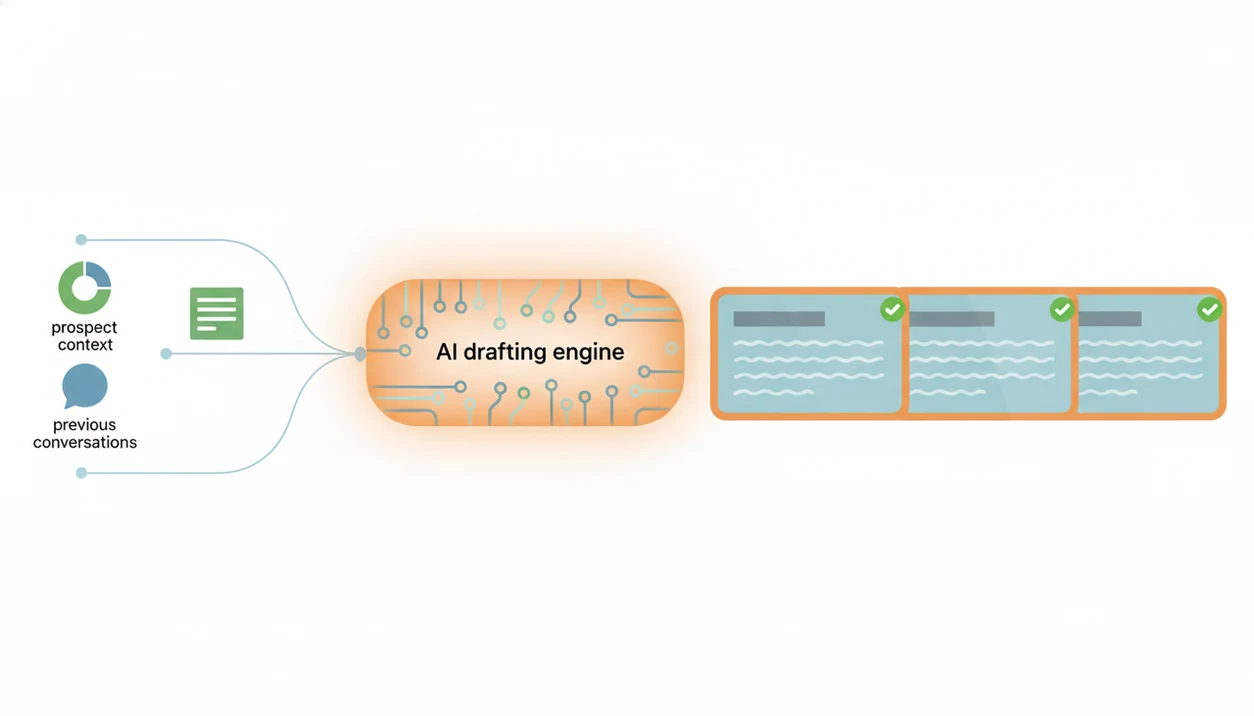
AI email tools for sales teams work by turning sales context into draft copy, then helping reps refine the message for relevance, tone, and timing. The useful inputs are prospect role, company context, offer, prior conversation, CRM fields, prompt instructions, and brand tone.
Under the hood, most tools use large language models, prompt templates, and sometimes CRM-connected retrieval. In plain English, the system predicts a likely useful email based on the details you provide. It may generate a cold intro, rewrite a rough note, suggest subject lines, summarize a call, analyze tone, or propose a follow-up.
Focused email generators differ from sequence automation and CRM-native AI. Email AI helps with the writing layer: drafts, rewrite passes, proofreading, and tone adjustment. Sales engagement platforms handle cadence execution. CRM assistants use pipeline records and account history.
The most useful AI sales email workflow improves the draft before a human sends it, not after a bad list has already received it. Check every claim, name, date, offer, and unsubscribe-related requirement before sending.
How to Use the Best Sales Email AI in an Outreach Workflow
Use sales email AI as a drafting and review layer inside a clear outreach process. It should not replace ICP thinking, prospect research, or manager review for sensitive campaigns.
- Set your ICP and goal before drafting, including role, company size, pain point, offer, and desired next step.
- Add prospect research such as company news, role responsibilities, prior interaction, or CRM notes.
- Generate the first email draft with a clear prompt, including tone, length, offer, and call to action.
- Personalize the message by adding one relevant detail that proves the email was not sent blindly.
- Review the copy for accuracy, tone, compliance, brand voice, and whether the ask is easy to answer.
- Track performance by reply rate, positive replies, meetings booked, time saved, and pipeline quality.
For sales teams that need a draft before lunch and a follow-up by 8:57 a.m. Monday, EmailAI fits because it supports quick generation and rewrite passes without forcing a new sales operating system.
Evaluation Criteria for AI Email Tools in Sales Teams
Sales teams should evaluate AI email tools by sales outcomes, not only by whether the copy sounds polished. Sales-specific tuning matters more than generic writing quality because cold outreach has a narrow job: earn a relevant reply without wasting the prospect’s time.
- Generation quality: The tool should create clear cold intros, follow-ups, meeting recaps, proposal nudges, referral asks, and objection responses.
- Personalization depth: Strong tools use prospect context, role, company details, and prior conversation without inventing facts.
- Workflow fit: Look for Gmail, Outlook, CRM, mobile, approval, and template workflows that match how reps already send.
- Performance measurement: Track reply rate, positive replies, meetings booked, time saved per rep, pipeline created, and opportunity quality.
- Governance and risk: Review privacy handling, user permissions, team templates, brand voice controls, and compliance review.
McKinsey estimated in 2023 that generative AI could create $0.8 trillion to $1.2 trillion in annual value across sales and marketing use cases, including content generation and personalization (https://www.mckinsey.com/capabilities/mckinsey-digital/our-insights/the-economic-potential-of-generative-ai-the-next-productivity-frontier). Salesforce’s State of Sales research has also reported that reps spend only 28% of their week selling, which is why drafting, CRM updates, and follow-up automation matter operationally (https://www.salesforce.com/resources/research-reports/state-of-sales/).
Good AI email generators and writing assistants deliver faster drafts, better rewrite options, and cleaner follow-ups, not automatic trust, qualified leads, or closed deals.
How We Chose the AI Email Tools for Sales Teams
We chose these AI email tools by looking at how well they support real sales writing, not how loudly vendors describe their AI. The shortlist covers focused email generators, sales engagement platforms, CRM-native assistants, cold outbound platforms, and coaching tools because each category solves a different part of the sales email workflow.
- Review tool categories by the job they perform: drafting and rewriting, sequencing, CRM context, outbound operations, or rep coaching.
- Score writing quality by clarity, specificity, tone control, subject-line usefulness, and whether the tool avoids fake personalization.
- Check workflow fit for the places reps already work, including inboxes, mobile, CRM notes, templates, and manager review.
- Assess governance around privacy, permissions, brand voice, approval controls, and safe use of prospect or customer data.
- Measure usefulness by practical sales signals such as time saved, reply quality, meeting creation, and repeatable team adoption.
We did not rank deliverability-only tools, list-building databases, enrichment products, or inbox warmup utilities as primary AI email tools. Email AI is the publisher’s own recommended focused-writing option, so its inclusion is based on that narrower fit: sales emails, rewrites, proofreading, subject lines, and tone edits rather than broad vendor claims.
Email AI as the Best AI Email Tool for Focused Sales Writing
Does Email AI work for sales teams that need better emails without a full outbound platform? Yes, Email AI fits reps, founders, account managers, and small teams that need sales email drafts, rewrites, proofreading, subject lines, and mobile email productivity.
Use it for a cold intro, follow-up after no reply, meeting recap, proposal nudge, referral ask, objection response, or short mobile reply. A rep can paste a rough note that says, “Can you make this sound less annoyed?” and run a tone adjustment before sending. The tiny subject-line field still may get rewritten three times. That is normal.
Email AI is not a CRM, lead database, dialer, inbox rotation tool, or multichannel sequencing system. Its fit is focused writing. For small teams, a focused AI email generator is often easier than a sales engagement platform because it improves the message without requiring a full cadence buildout.
On days when a proposal nudge needs to sound firm but not pushy, Email AI handles the rewrite pass with a specific business-email workflow.
Best Sales Email AI for High-Volume SDR Sequences
High-volume SDR teams usually need a sales engagement platform with AI, not only a standalone writer. The reason is operational: sequences, task queues, automated follow-ups, CRM sync, team templates, and analytics matter once many reps are contacting many accounts.
These teams often work across email, LinkedIn, phone, and SMS because inboxes are crowded. They also need deliverability controls, including warmup, inbox rotation, spam-trigger avoidance, throttling, and sending limits. Copy.ai, chatgpt.com, and generic writing tools can help with draft ideas, but they do not manage the sending system.
Volume is not a strategy by itself.
Higher sending volume can hurt results if list quality, consent rules, segmentation, and message relevance are weak. A/B subject lines in two tabs may feel productive, but the real test is qualified meetings booked. For SDR teams, sales engagement AI tends to work best when the team has clean lists, clear targeting, and a manager reviewing templates before launch.
Best AI Email App for Sales Teams by Role
Different sales roles need different AI email support. SDRs often need volume and sequencing, while AEs need deal context, high personalization, and accurate next-step language.
| Role | Best-fit tool type | Reason |
|---|---|---|
| SDR | Sales engagement AI | Sequences, automated follow-ups, task queues, and volume analytics |
| AE | CRM-native assistant or focused AI email generator | Deal context, meeting recaps, proposal nudges, and personal follow-ups |
| Founder | Focused AI email generator | Fast outreach without adopting a large sales stack |
| Account manager | Focused AI email generator | Renewal notes, expansion asks, customer replies, and tone adjustment |
| Customer success | AI email writer or CRM-native assistant | Recaps, support handoffs, risk notes, and executive updates |
| Recruiter | Focused AI email generator | Candidate outreach, follow-ups, and hiring-manager messages |
| Sales leader | Coaching and analytics tools | Template review, tone coaching, adoption tracking, and performance comparison |
For junior reps, AI email coaching can improve brevity, tone, clarity, and call-to-action structure. The highlighted sentence that sounds too sharp is often where the coaching matters most.
If a team needs cleaner human-reviewed outreach more than automated sequencing, Email AI is a practical fit because it supports drafts, proofreading, and tone edits across common sales email moments.
Limitations
AI sales email tools are useful, but they do not fix weak sales strategy. The main risks show up when teams automate before they understand the audience.
- AI emails can sound generic or off-brand without strong prompts, examples, and human editing.
- AI does not replace prospecting, qualification, discovery calls, relationship building, or offer-market fit.
- Poor list quality and aggressive volume can still damage deliverability, even when the copy looks clean.
- Sensitive prospect or customer data creates privacy, security, and governance risks if teams paste it into the wrong system.
- Vendor claims about massive reply-rate gains may rely on case studies rather than independent evidence.
- Overreliance can weaken junior reps’ writing judgment if managers stop coaching.
- CRM-native tools may be too rigid for quick one-off messages.
- Standalone writers may create copy that reps must manually move into CRM records.
- Sales engagement platforms can be overkill for founders, recruiters, and small account teams.
- Compliance still depends on targeting, consent rules, disclosures, unsubscribe handling, and local law.
Footer links people ignore, like Privacy Policy, Terms, and unsubscribe text, matter more when AI increases sending speed.
Read more
FAQ
What is sales email AI?
Sales email AI is software that drafts, rewrites, personalizes, and improves sales emails. It can help with cold outreach, follow-ups, subject lines, tone, and response drafts.
Which AI tool writes cold emails?
Focused AI email generators, cold outbound platforms, sales engagement tools, and generic AI writers can all write cold emails. The right choice depends on whether you need better copy, campaign sending, CRM context, or deliverability controls.
Are AI sales emails legal?
AI sales emails can be legal, but legality depends on consent, targeting, disclosures, unsubscribe handling, and local regulations. Teams should review applicable rules before sending automated or high-volume outreach.
Can AI improve sales email reply rates?
AI can improve reply rates by making emails clearer, shorter, and more personalized. Results still depend on list quality, offer relevance, timing, and human review.
Do sales teams need CRM integration for AI email?
CRM integration is essential when reps depend on pipeline history, account notes, and activity logging. A standalone email writer can be enough for smaller teams or one-off outreach.
Which free AI email tool should sales teams test first?
Free AI email tools can help teams test drafting, rewriting, and subject lines. Paid tools usually add stronger workflow controls, governance, team templates, integrations, and analytics.
Can AI write sales follow-up emails?
Yes, AI can write follow-up sequences, meeting recaps, objection responses, and polite nudges. Reps should review each follow-up for timing, accuracy, and relevance.
Does AI hurt email deliverability?
AI copy alone does not determine deliverability. Sending behavior, list quality, spam signals, domain reputation, volume, and compliance practices also matter.
How should sales teams measure AI email performance?
Sales teams should measure time saved, reply rate, positive replies, meetings booked, pipeline created, and opportunity quality. Adoption by reps also matters because unused tools do not improve results.
Write better sales emails faster
Use Email AI to turn prospect notes, follow-up ideas, and rough drafts into clear, professional sales emails you can review and send with confidence.
Download the AI email writer