
Cold Email Generator with Templates That Get Replies
Updated
Cold emails get answered when they are short, specific and clearly meant for one person. This page gives you five templates, a formula and personalization lines. When you'd rather draft on your phone, the cold email app for iPhone and the cold email app on Google Play both have a Cold Outreach chatbot that writes the first version for you.


The formula behind every cold email that works
Strip away the templates and nearly every good cold email has four parts, in this order.
- A reason for writing to this person in particular.
- What you want or what you offer, in one sentence.
- One piece of proof, such as a result, a client name or a mutual contact.
- A small question that can be answered with a yes, a no or one line.
Length: aim for 50 to 120 words. People read cold email on a phone between other things, so if the message needs scrolling, it is probably too long. Put the ask in the last sentence, and make it small. "Worth a 15-minute call?" gets more answers than "Let me know your thoughts."
One more habit: write about them first, you second. An email that opens with "I am the founder of..." reads like a flyer.
Personalization lines you can borrow
The first line is where cold emails die. "I hope this finds you well" tells the reader you pasted this into 200 inboxes. A good opener shows you looked at something real and took about two minutes to do it.
- I read your post about moving support to a four-day queue, and the part about backlog caps was useful.
- Saw that [Company] opened a second warehouse in [city]. Congratulations.
- You spoke at [event] last month; your point about [topic] stuck with me.
- Your team is hiring a [role], which usually means [problem] is on your plate.
- We both know [mutual contact], who suggested I write.
Avoid flattery you can't back up. "I love what you're doing" says nothing. A detail, even a small one, says you were paying attention.
Cold email template for B2B sales
Sales emails are the most deleted kind, so keep this one very short and lead with a problem the buyer probably has, not with your product.
Hi [Name],
I saw [Company] is hiring three support reps, so I'm guessing ticket volume is climbing.
We help teams of your size cut first-response time by sorting tickets before an agent opens them. [Client] went from [X] hours to [Y] hours in [timeframe].
Would it be useful if I sent a two-minute walkthrough?
Best,
[Your name]
[Title], [Company]
Notice there is no pricing, no feature list and no attachment. The goal of the first email is a reply, not a sale.
Cold email template for a freelancer pitching a client
Freelancers do best when the email contains a small, free observation about the client's work. It proves skill without asking for trust up front.
Hi [Name],
I was on your pricing page and noticed the signup button sits below the fold on mobile. On the three comparable sites I checked, it sits above.
I'm a freelance conversion designer, and I've fixed this kind of thing for [Client] and [Client]. I can send a short list of three fixes for your page, no charge.
Want me to send it over?
Thanks,
[Your name]
[Portfolio link]
Check the observation is true before you send it. A wrong "you're missing X" ends the conversation immediately.
How to write a cold email to a potential employer
A job seeker writing to a hiring manager has one advantage: the reader may already have a gap to fill. Name the role or the team, give one relevant result, and ask for a short conversation, not a job.
Hi [Name],
I follow [Company]'s work on [product], and I noticed the open [role] posting. In my last role at [Company], I [result with a number], which looks close to what that team is doing.
My resume is attached. If the role is still open, could I send two or three examples of that work?
Thank you,
[Your name]
[Phone]
If you're writing before any opening exists, change the middle line to "I'd like to learn how your team handles [problem]." Our guide on how to introduce yourself in an email covers the opening lines in more detail.
Templates for partnerships and for asking an expert
Partnership
Say exactly what each side gets. Vague "synergy" emails go nowhere.
Hi [Name],
Your newsletter reaches [audience], and we serve the same people with [product]. A few of your readers have probably asked about [topic].
I'd suggest a joint webinar on [topic]: you bring the audience, we handle the slides and send you the signup list.
Open to a 15-minute call next week?
Best,
[Your name]
Asking an expert for advice
Make the question narrow enough to answer in two minutes. Never ask "can I pick your brain?"
Hi [Name],
Your talk on [topic] changed how I set up [thing]. I'm now facing [specific problem], and I'm deciding between [option A] and [option B].
If you have a minute, which would you pick, and why? A one-line answer would help a lot.
Thank you,
[Your name]
Sending cold email at volume without being rude
Volume is fine. Copy-paste spam is not. Write each message for one person and send it from your own address, one at a time. If you need to reach a list, see how to send an email to multiple recipients individually so nobody sees anyone else's address.
For commercial email, such as sales outreach, the US CAN-SPAM Act expects a real sender identity, a truthful subject line, a physical postal address and a working way to opt out. Honor opt-outs quickly. This is general information, not legal advice, and rules differ in other countries, so check yours before a large send.
Two habits help: stop after one polite follow-up or two, and don't resend the same text. A short follow-up email generator page can help with that second message, and an email subject line generator can give you options for the subject, which decides whether the email is opened at all.
Drafting cold emails with FlyMail's Cold Outreach chatbot
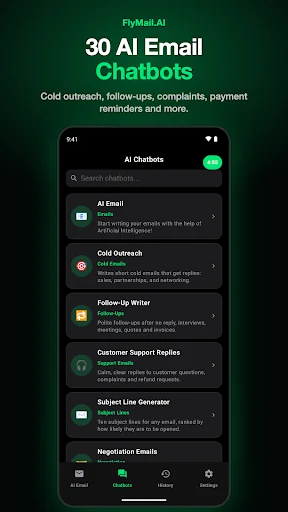
You can draft cold emails in FlyMail on your phone or tablet, on iOS or Android, then send them from the mail app you already use. Its Chatbots tab has a Cold Outreach bot built for short cold emails for sales, partnerships and networking. You describe the situation in a sentence, for example "pitch a landscaping client on a website redesign, mention their new location," and it returns a draft.
Because it works as a chat, you can reply "make it shorter" or "more formal" and get a revised version. In Text Preferences you can pick a Short length and a tone such as Professional or Friendly.
Give it the personalization detail yourself. FlyMail doesn't know your history with the recipient, and a vague request gets a generic email. It can also invent dates or numbers, so read the draft before sending. FlyMail doesn't connect to your inbox; you copy or share the result into Gmail, Outlook or Apple Mail.
Frequently asked questions
How long should a cold email be?
Keep it between 50 and 120 words, or about 4 to 6 sentences. If a reader needs to scroll on a phone, shorten it.
What is a good cold email template?
Use four parts: a reason you chose this person, what you offer or need, one piece of proof, and a small question. The templates above apply that structure to sales, freelance, job, partnership and expert-advice emails.
Can AI write a cold email for me?
Yes. FlyMail's Cold Outreach chatbot writes a short cold email from one sentence describing your goal and the recipient, and you can ask it to adjust the length or tone.
How do I write a cold email to a potential employer?
Name the role or team, give one relevant result with a number, and ask for a short conversation rather than a job. Keep it under about 120 words.
Is cold emailing legal?
In the US, commercial cold email is allowed if it follows CAN-SPAM, including a truthful subject line, a physical address and an opt-out. Rules vary by country, so check local law.
How many times should I follow up on a cold email?
One or two short follow-ups spaced several days apart is enough. After that, stop.
Try FlyMail on your phone
Free download for iPhone, iPad and Android. Write, reply, fix grammar and change tone in one app.